How to Get Patients to Come Back
Your Past Patients Didn't Leave. They Drifted.
Every cosmetic practice has a list of people who came in once, twice, maybe for years, and then stopped booking. The Botox patient from last spring. The Invisalign consult who went quiet after getting the price. The filler client whose touch-up date came and went.
Most of them didn't leave unhappy. Life got busy, the routine broke, and nobody reached out. They already know your practice and trust your providers. That makes them the easiest appointments you'll ever book, and you already paid to bring them in once.
This guide is for owners of med spas, plastic surgery practices, cosmetic dental offices and orthodontic practices. It covers how to find those patients, what to say, how to handle their replies, and how to tell whether it's working.

What counts as a lapsed patient?
A patient is lapsed when they've gone well past their normal return date. The simple rule: take how often a treatment usually repeats, multiply by about 1.5, and reach out once a patient passes that point. Too early and you're messaging people who were about to book anyway. Too late and they've moved on.
Treatment | Usually repeats every | Reach out after |
|---|---|---|
Neurotoxin (Botox, Dysport) | 3–4 months | 5–6 months |
Dermal filler | 6–12 months | 12–18 months |
Facials, peels, laser series | 4–8 weeks | 3 months |
Dental cleaning and exam | 6 months | 9 months |
Ortho retainer check | 6–12 months | 12 months |
These are typical cycles. Use your own providers' recommendations if they differ.
Unfinished consults are their own group
Some of your best opportunities never became patients at all. A breast augmentation consult that didn't book surgery. A veneers or Invisalign consult who said "let me think about it." These people already told you what they want. They're usually waiting on timing, financing, or one more conversation.
Keep them separate from lapsed patients. They need a different message: "Are you still thinking about it?" instead of "We haven't seen you in a while."
Pull your list in ten minutes
You don't need a fancy scoring model to start. Three filters in your practice software get you most of the way there:
Last visit between 6 and 18 months ago. Recent enough that they remember you, long enough that they've clearly fallen off.
Two or more past visits. These were real patients with a routine, not one-time walk-ins.
A valid phone or email, with permission to contact them. If you can't reach them, or they haven't agreed to hear from you, they don't belong on the list.
Sort by most recent visit first. The patients at the top are the warmest.
Who to leave off
Anyone who already has a future appointment booked
Anyone who asked not to be contacted or unsubscribed
Anyone with an open complaint, refund request or billing dispute
Anyone who told you they moved away or found another provider for good
Anyone you've sent a reactivation campaign to in the last 90 days
Cleaning the list first protects your reputation. It also means every message goes to someone who might actually say yes.
Why patients drift
When a patient stops coming in, it's tempting to assume something went wrong. Usually nothing did. Behavioral researchers call it the gap between intending and acting: people fully mean to do something, then don't, until something prompts them.
For a cosmetic patient, the prompt used to be routine. They booked their next visit before leaving, or their brow lines reminded them it was time. Once that routine breaks, it goes something like this:
"I'll book next week."
"I really need to get in there."
"It's been so long, it feels awkward to call now."
They stop thinking about it.
That third step matters most. Many lapsed patients feel a little embarrassed about how long it's been. A friendly message from your practice removes the awkwardness. It says we noticed, we'd love to see you, and here's an easy way back in.
That's why your past patient list isn't a list of people who left. It's a list of people waiting for someone to reach out first.
Give a real reason to come back, not a discount
The reflex is to send "20% off, we miss you!" It works once. Then it teaches patients to wait for the next sale, and it quietly tells them your regular price wasn't worth it.
Start with the lightest touch, and only move down the ladder if a group doesn't respond:
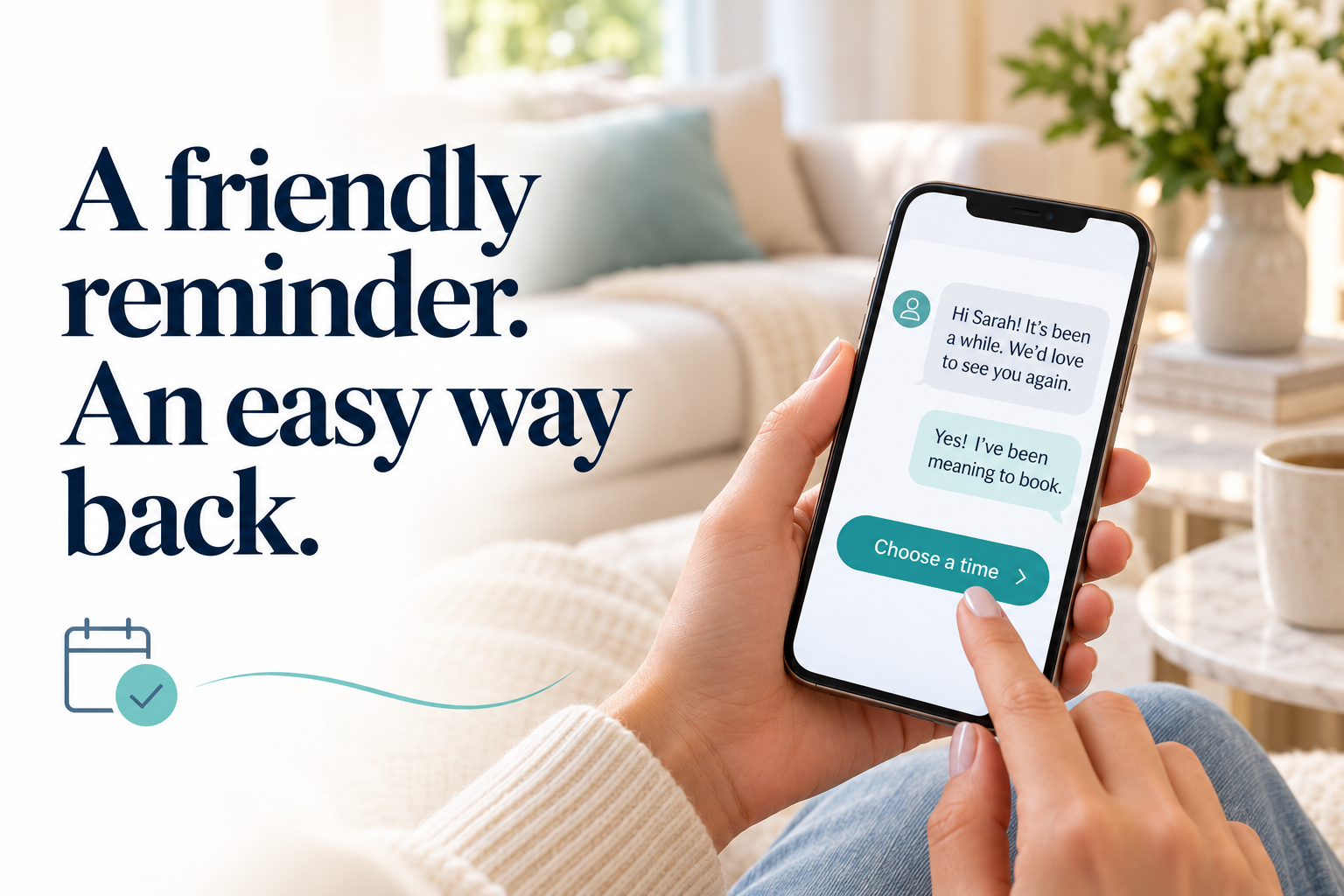
A simple, friendly reminder. "It's been a while, and we'd love to see you. Here's a link to book." For many patients, this is all it takes.
Something new at the practice. A new provider, a new laser, a new technique, extended hours. This gives them a reason that has nothing to do with price.
A small add-on. A complimentary upgrade with their next treatment, like a brow tint, a booster or whitening trays.
A discount, last. Keep it modest and time-limited, and save it for groups that didn't respond to anything else.
The second rung is the most underused. A new nurse practitioner or a new treatment is real news, and patients are glad to hear it.
Let a system do the follow-up
Most practices know all of this already. The problem is time. Your front desk is busy with the patients in front of them, and reaching out to 2,000 past patients by hand never makes it to the top of the list.
An automated reactivation system takes that off your team's plate:
It finds the right patients. It pulls everyone past their return date and sorts them by how warm they are.
It reaches out with the right message. Texts and emails go out in your practice's voice, with a real reason to come back. You approve every message before anything is sent.
It answers replies right away. When a patient writes back "yes, I've been meaning to," they get an answer in minutes, not the next afternoon. Fast answers are what turn interest into a booking.
It books them onto your calendar. Patients pick an open time without waiting on hold.
It hands off what it shouldn't handle. Anything clinical goes straight to your team.
Your team's job shrinks to greeting the patients who show up.
How to answer the six most common replies
The reply is where a reactivation campaign wins or loses. Every good answer follows the same pattern: agree with them first, ask a simple question, then offer an easy next step. Never argue.
"Not interested." Usually a reflex, not a final answer. "Totally fair, no pressure at all. We just noticed it had been a while and wanted to check in. Is there anything we could do better for you?"
"It's too expensive right now." Often means "I'm not sure it's worth it anymore." Remind them what they loved before you mention any offer. "Completely understand. When you were coming in, what did you love most about your results?"
"I went somewhere else." Stay gracious. "So glad you found someone! If you ever want a second opinion or a touch-up, we're here." Pushing here burns the bridge for good.
"I had a bad experience." This one deserves a real person. Apologize, ask what happened, and have the owner or practice manager follow up personally. Most unhappy patients never told anyone. They just left.
"I'll think about it." Give them a specific next step. "Of course! Want me to check back next Tuesday, or send you a couple of open times now?"
"I don't have time." Make it easy. "Totally get it. What day used to work best for you? I can hold that spot."
If someone asks to stop receiving messages, remove them right away. It's the right thing to do, and the law requires it.
Measure bookings and shows, not opens
Open rates and replies feel good, but they don't pay your providers. Track the numbers that end in revenue:
What to track | What it tells you |
|---|---|
Replies | Whether your message landed |
Booked appointments | Whether replies turned into real interest |
Showed appointments | Whether bookings were solid, not polite yeses |
Paid treatments | What the campaign actually earned |
Rebooked within 90 days | Whether patients are back for good |
Show rate deserves extra attention. A patient who books and doesn't show isn't a win. Confirmation texts the day before make a real difference.
Keep it running every month
Reactivation isn't a one-time campaign. New patients drift past their return date every month. A system that checks your list monthly and reaches out as soon as someone passes their date catches them while they still remember you fondly.
What this looks like in real life
Dr. Rivera had just brought a new nurse practitioner onto her team. Instead of sending her past patients a coupon, we gave them a real reason to come back: come meet our new NP.
We reached out to 1,200 past patients. 340 replied. 112 booked. 87 showed up. That added up to $43,600 in fourteen days, with no new ad spend and no discounts. Every one of those patients was already in her database.
Find out what's sitting in your list
If you'd like to know what your own past patients could book, start with a free 20-Minute Patient Comeback Plan. We'll look at the size of your list and how you follow up today, and show you what a 30-day reactivation could bring in. No patient records needed for the first call.
